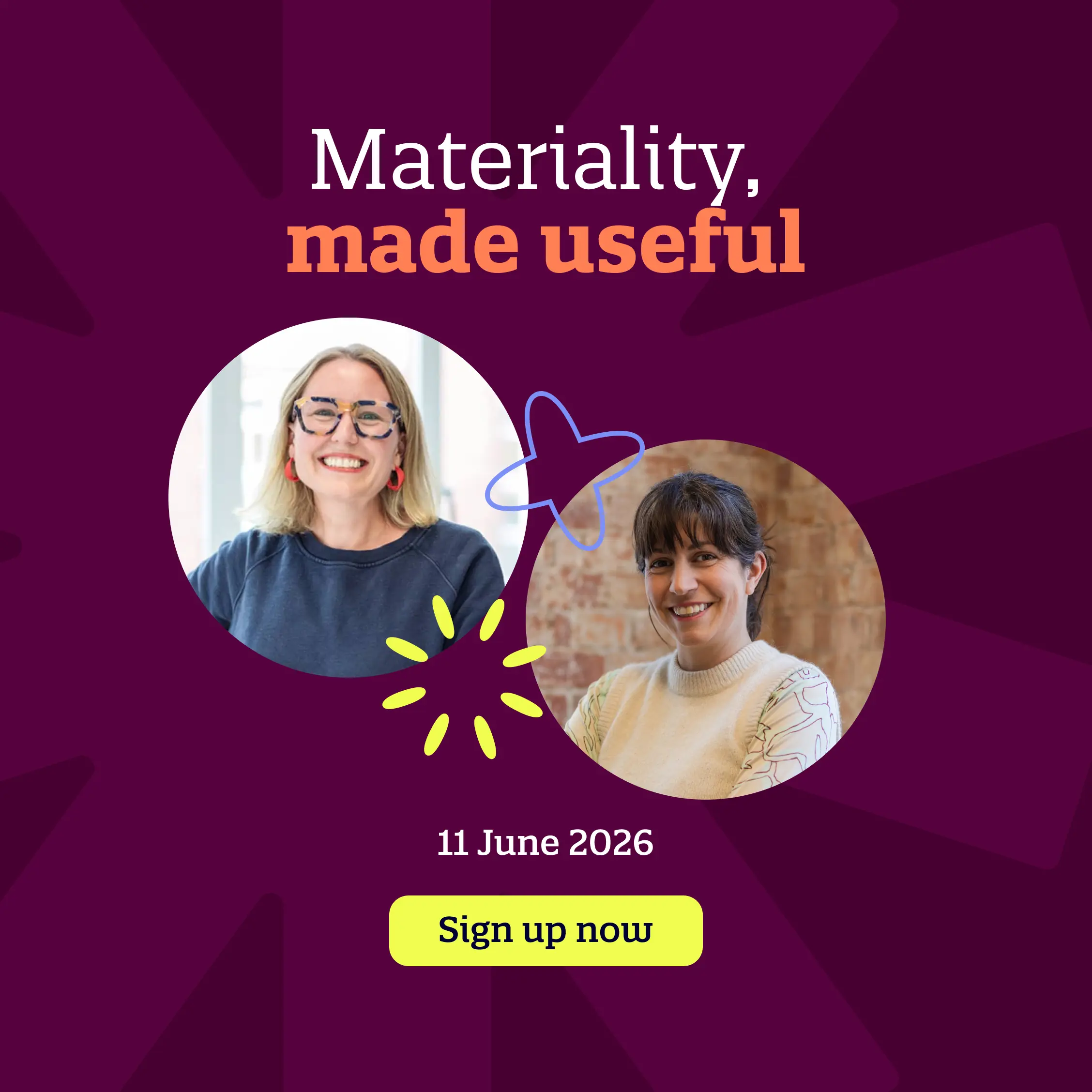
Materiality, made useful

Hannah Nascimento
Sustainability DirectorMany organisations have completed materiality assessments — running surveys, scoring topics, and mapping matrices — yet still struggle to turn the results into something meaningful.
The issue isn’t the methodology. It’s that materiality processes often become over-engineered, misaligned, or disconnected from decision-making. Definitions vary, thresholds aren’t agreed, and outputs end up sitting in reports rather than shaping strategy.
This 30-minute webinar explores why materiality so often fails to deliver real value — and how to fix it.
We’ll look at how a compliance aligned but judgement-led approach can cut through complexity to:
- Focus on what truly drives business value
- Align ownership across teams and functions
- Turn ESG priorities into clear, defensible decisions
- Move from compliance exercise to strategic tool
Date: 11 June, 12:00pm
If your materiality work feels complete on paper but unclear in practice, this session will help you rethink how it’s designed, delivered and used.
Sign up below:




Luminous accelerates Australian market entry through strategic partnership with Sodali & Co
Luminous, a strategic advisory and creative studio specialising in corporate reporting, sustainability, brand and digital communication, has accelerated its entry into the Australian market through a strategic partnership with Sodali & Co, the leading global capital markets-centric stakeholder advisory firm.
Under the strategic partnership, Sodali & Co’s Sydney-based Brand & Design team (formerly Designate) has transitioned to Luminous, with Luminous agreeing to take on all active client projects, ensuring continuity of service.
A timely moment to enter the Australian market
Australia is entering a period of complexity in corporate markets with mandatory climate-related disclosures, increased investor scrutiny and the growing use of digital and AI. The challenge for many organisations is navigating this complexity while telling a clear and consistent performance story that translates well across reporting, sustainability, brand and digital channels.
Luminous’ integrated approach is designed to help companies do exactly that, drawing on experience with global businesses including Aston Martin, Coca-Cola HBC and Legal & General, by combining this expertise with local leadership with deep knowledge of the ASX and the Australian communications landscape, Luminous hopes to disrupt the market and elevate the more progressive businesses.
Strong local leadership, backed by global capability
Luminous’ Australian presence is led by Roger Lindeback, Managing Director, who brings more than 35 years’ experience advising ASX-listed and multinational companies across corporate reporting and brand development. Roger founded and led Designate and helped integrate it into Sodali; the client relationships built over that time form the foundation of Luminous’ Australian business. His background includes working with a wide range of businesses operating in regulated, high-scrutiny environments.
The creative team in Australia is led by Andrew Nobbs, Creative Director, who brings extensive experience shaping corporate and investor-facing communications for large, complex businesses. Andrew has delivered reporting and brand work across regulated sectors and works closely with leadership teams to ensure strategy, content and creative execution are aligned.
Round-the-clock capability and shared resources
One of the distinctive advantages of Luminous’ Australian presence is the production capability it unlocks across time zones. With Australia’s reporting season running broadly opposite to the UK, most ASX-listed companies report to a June year-end, meaning the two teams can complement each other through peak periods in each market.
In practice, clients benefit from extended evening production hours, faster turnaround times and a seamless global delivery model that operates around the clock. Shared resource planning across the UK and Australian studios also brings greater consistency and capacity during the most demanding periods of the reporting calendar.
Australian clients are further supported by Luminous’ strong technical expertise across leading reporting platforms. The agency has delivered more than 150 reports using CtrlPrint and is a certified Workiva partner, helping companies manage complex reporting processes with greater control and confidence.
Sustainability at the core
Sustainability is a core strength of the Luminous offer, shaped by years of work in mature regulatory environments across the UK and Europe. Luminous supports companies to communicate their position in a way that is clear, coherent and human.
As Australian companies face increasing pressure to meet new disclosure standards, Luminous brings practical experience of what good looks like and how to get there.
“This represents an exciting new chapter for Luminous as we grow our international footprint in this exciting and fast-changing market. We see particular synergies on the IR side of our business as Australia rapidly catches up with Europe in terms of reporting complexity. Through building strong brands, embracing sustainability and enhancing investor engagement, we plan to further enhance our reputation as strategic storytellers and to embrace the shared expertise in this exciting strategic partnership with Sodali.”
Alan Hines, Co-Founder, Luminous
“Australian companies are being asked to communicate more, with greater precision and under closer scrutiny. This partnership brings together the local expertise and relationships our clients already trust, with international creative and strategic depth that will raise the bar for what is possible. I am proud of what we built with Designate, and even more excited about what we will build together as part of Luminous.”
Roger Lindeback, Managing Director, Luminous Australia
“Our Brand and Design team has built a strong track record over many years supporting a high-quality list of Australian clients with their annual reporting suite, sustainability reporting and creative branding requirements. Our priority has been to find the right partner to take the business forward, bringing relevant expertise and a commitment to investing further in creative capabilities so the team can continue to flourish. We have found that partner in Luminous and are excited to partner together in support of our shared clients.”
Elizabth Micci, Global Head of Strategic Communications, Sodali


Kickstarting Your UK SRS Journey: Key insights from our webinar
Hannah Nascimento
Sustainability Director
Stephen Butler
Advisory & Reporting DirectorOn 9 June, we hosted a 30-minute webinar to help organisations take their first steps on the UK Sustainability Reporting Standards (UK SRS) journey. With mandatory reporting fast approaching for listed companies, the session brought together sustainability professionals, finance leaders and corporate reporters to explore what the new standards mean in practice – and where to focus first.
Here’s a summary of what we covered.
The biggest shift in financial reporting in 20 years
UK SRS represents the most significant development in financial reporting since the Companies Act was last updated in 2006. While the standards are currently voluntary, mandatory reporting for listed companies kicks in from 1 January 2027, with first reports published in 2028.
Key milestones to keep in mind:
2028: S2 (climate reporting) becomes mandatory for listed companies. Scope 3 is excluded initially but moves to ‘comply or explain’ in 2028.
2029: S1 (all other financially material sustainability topics) comes in on a ‘comply or explain’ basis, with full coverage expected from that point.
Important: S2 is not a like-for-like replacement for TCFD. It goes meaningfully further — with deeper quantification requirements and financial connectivity.
S1 and S2: think of them as one, not two
Resist the temptation of treating S1 and S2 as separate projects. The timeline can make it feel logical to focus on climate first and park S1 for later – but that’s a trap.
S1 covers sustainability topics beyond climate that are financially material, and critically, it is genuinely new territory. There is no existing TCFD equivalent to build on. S2 already draws on parts of S1 – such as materiality assessments and quantitative characteristics – so the two cannot be cleanly separated. Arriving at 2029 with a mature S2 and an underdeveloped S1 will create a very visible imbalance in your reporting.
What UK SRS actually requires your business to do
Two foundational concepts underpin everything:
Financial materiality: Not just what matters to the business generally, but what risks or opportunities could reasonably move your cash flows, access to finance, or cost of capital.
Value chain lens: You cannot limit your view to your own operations. Financially material risks and opportunities must be assessed both upstream and downstream.
Reporting is structured around four familiar pillars – governance, strategy, risk and metrics – but the bar has shifted significantly. The question is no longer “do you have a process?” but “is it embedded, and is it delivering outcomes?”
For example:
Governance requires named accountability at board level, not just a statement that the board owns sustainability.
Strategy means demonstrating how risks and opportunities are shaping capital allocation and how metrics tie to financial outcomes and pay.
Risk management must sit inside the enterprise risk framework — same thresholds, same escalation points — not in a separate sustainability register.
Financial materiality: a step forward, but not the full picture
Financial materiality is a genuinely important development – it cuts through noise, commands attention from those who control capital, and is long overdue as part of the conversation. But it is not a substitute for understanding your broader impacts.
Businesses still need to consider double materiality: the risks and opportunities that aren’t financially material today but may well be in the future, and what their stakeholders expect. Credibility rests on holding an integrated view of what matters – not shrinking the picture.
Why start now?
Done well, UK SRS is not a compliance exercise — it is a strategic assessment. Companies that approach it that way will see risks earlier, strengthen trust with investors, and build genuine resilience. Those that defer are likely to face a harder implementation challenge when assurance requirements bite.
The implementation challenges Hannah highlighted that take time to get right:
Data quality that will hold up to audit-level scrutiny
Scope 3 data, which is supplier-dependent and often patchy
Connectivity between sustainability and financial reporting narratives
Assurance-ready processes and internal controls
Getting boards, finance, and sustainability speaking one language
How we can help
Our Luminar Insights tool – Luminous’ proprietary AI platform — is designed to accelerate this work. It supports materiality reviews, gap analysis, financial connectivity mapping, peer benchmarking, and prioritised action planning, getting teams to a clear starting point significantly faster.
If you would like to explore how we can support your UK SRS programme, please get in touch with Hannah or Stephen.
Missed the webinar? Watch the recording or download the deck using the links provided.


In Conversation: Matt Juden-Bloomfield, edie 100 Sustainability Leader
Hannah Nascimento
Sustainability DirectorFollowing his nomination for the edie 100, recognising the UK’s most impactful sustainability leaders – our Sustainability Director, Hannah Nascimento, sat down with Lidl GB’s Head of Sustainability, Matthew Juden-Bloomfield.
Together, they explore what the nomination means, how Lidl is embedding sustainability into the core of its business, and why the future of sustainability is about integration, not intention.
Key takeaways
Building on our work together on Lidl’s Beyond the Basket Sustainability Report, the conversation explores Matt’s journey into sustainability, how he’s driving change across the business, and where he sees the function evolving next.
Sustainability isn’t a separate job — it’s already happening across the business
One of Matt’s biggest focuses has been shifting the perception that sustainability is “extra” work.
At Lidl, many sustainability outcomes already exist within day-to-day operations — from reducing waste to optimising energy use — the challenge is helping teams recognise and build on what they’re already doing.
Making sustainability tangible is what drives engagement
Rather than complex frameworks, Matt emphasises simplicity and relevance.
Breaking sustainability down into clear, digestible actions and facts — from food donation rules to energy usage — helps colleagues understand what they can do and why it matters.
No two days look the same — and that’s the point
From board-level strategy discussions to community engagement and school workshops, Matt’s role spans the full spectrum of the business.
Sustainability, in practice, is as much about people and influence as it is about data and targets.
The future is integration — not separate sustainability strategies
Matt compares sustainability today to digital in the early 2000s — currently a specialist function, but moving towards full integration.
The direction of travel is clear:
Sustainability embedded into commercial strategy
Linked to performance and accountability
Owned at the highest levels of the business
Sustainability and commercial success are not in conflict
A key misconception Matt challenges is that sustainability means restricting business. Instead, he sees his role as helping businesses do what they already do — just better, balancing commercial performance with positive impact across stakeholders and the planet.
Watch the full conversation
Matthew Juden on embedding sustainability at scale — and why progress often starts with what’s already there.
Visit the case study
If you’d like to learn more about our work with Lidl or the Beyond the Basket report, get in touch.


Kick-starting UK SRS

Grace Tanner
Senior ConsultantThe long‑awaited final UK Sustainability Reporting Standards (UK SRS) have now landed. Built on the work of the IFRS Foundation, they are designed to help companies provide consistent, comparable and decision‑useful reporting on sustainability and climate‑related financial information, risks and opportunities, in line with emerging international practice.
From February 2026, the Standards are available for voluntary use in the UK. In parallel, the FCA is consulting on how they should apply to listed companies. Further to this, Government has signalled that, as part of its wider review of corporate reporting, it will also look at whether large private companies should be brought into scope over time.
What are the main changes compared to ISSB?
Simultaneous reporting
Under UK SRS, sustainability disclosures are expected to be published at the same time as the financial statements from year one. This pushes companies to integrate sustainability into their core corporate reporting processes, rather than treating it as a bolt-on report produced on a different timetable.
Climate-first transitional relief
The standards extend the ‘climate-first’ transitional relief to two years. This gives companies the option to focus initially on climate-related disclosures before broadening to wider sustainability topics, creating breathing space to build internal capabilities, processes and controls.
Scope 3 emissions reporting
UK SRS provides a full first year exemption from Scope 3 greenhouse gas emissions, including financed emissions. The Standard no longer specifies how long this relief can be used. Instead, it leaves the duration of any Scope 3 relief to be set by the relevant regulators, if and when reporting becomes mandatory. In practice, this gives preparers short-term flexibility but also means they will need to keep a close eye on regulatory developments.
Use of industry standards
The original IFRS S1 and S2 Standards state that an entity ‘shall refer’ to SASB Standards. The UK version softens this, saying an entity ‘may refer’ to SASB Standards. The direction of travel is still towards industry-specific, decision-useful metrics, but with more discretion for preparers.
Companies are no longer required to use the Global Industry Classification Standard (GICS) as their prescribed industry classification system. Instead, they can use another suitable and commonly used system – often the one already used for prudential, regulatory or internal reporting. This removes the need to adopt GICS solely for UK SRS purposes and avoids unnecessary remapping.
What will successful implementation hinge on?
- Strategic planning – deciding how to use transitional reliefs, sequencing climate and wider sustainability topics and setting a realistic roadmap.
- Governance readiness – ensuring the board and its committees have clear oversight, the right skills and good‑quality information on sustainability‑related risks and opportunities.
- Data and systems – building or strengthening the infrastructure needed to gather, validate and connect emissions, scenario analysis and value‑chain data with financial information.
- Cross‑functional collaboration – bringing together sustainability, finance, risk, legal and investor relations so that narrative, metrics and financial effects tell a coherent story.
Ready to kick-start your journey?
It’s pretty clear UK SRS will become embedded into formal reporting requirements for listed companies and, in time, for larger private groups. Early adopters will be better placed to respond to investor expectations, regulatory change and stakeholder scrutiny.
Our approach
- Run a gap analysis comparing existing TCFD and broader sustainability reporting against UK SRS S1 and S2.
- Refresh your materiality assessment to identify sustainability‑related risks and opportunities that genuinely affect the business’s prospects.
- Review governance arrangements, including whether the board and its committees have the skills, structures and information they need to oversee climate and wider sustainability.
- Assess the maturity of your data, systems and controls, particularly for Scope 3 emissions and scenario analysis.
If you’d like to understand what UK SRS means for your business, benchmark your current disclosures or shape a practical implementation roadmap, get in touch to discuss how we can support your reporting.


Why creativity matters more than ever

Anna Tugetam
Brand DirectorOn 26 March, Luminous hosted a 30-minute webinar exploring why creativity matters more than ever in B2B.
About the session
As content becomes easier to produce, differentiation becomes harder to achieve.
In this session, we explored how strong brands cut through — not by saying more, but by being clearer, more distinctive and more creatively confident.
Drawing on examples including Doxis, Informa, Nvidia, Big Ass Fans and Coca-Cola, we looked at how businesses can better define and express what makes them different.
Key takeaways
Your USP is often not what you think it is
Strong brands outperform when they lead with clarity, not volume
Distinctive assets are built through consistency and intentionality
Creativity remains one of the most powerful commercial levers in B2B
Complimentary brand audits
We’re currently offering a limited number of complimentary brand audits – a practical review of your brand, covering both creative and messaging, with clear recommendations on where to strengthen and differentiate.
To find out more, get in touch with the team.




The materiality trap: when process crowds out priorities
Hannah Nascimento
Sustainability DirectorYou’ve followed the process. Scored the issues. Run the stakeholder survey. And yet, you’re still drowning in topics. The business nods politely but doesn’t change how it operates. Leaders see the matrix but don’t know what to do with it. And when someone asks what actually matters most, the answer is… everything, apparently.
The problem isn’t that you did it wrong. It’s that materiality, as typically run, doesn’t deliver as much value as it could. The process is compliant. The output is a matrix or a list. But the assessment hasn’t created the clarity, consensus or momentum it was supposed to.
If this sounds familiar, the issue probably isn’t methodology. It’s something deeper.
Why materiality doesn’t deliver
- Misalignment before the process starts. Different functions bring different lenses to materiality. Sustainability teams lean toward impacts. Risk leans toward financial exposure. Legal and compliance focus on obligations and controls. Strategy focuses on value creation. And the rest of the business is focused on quarterly numbers.
Three things tend to get in the way.
Without alignment up front – on definitions, thresholds and what the assessment is supposed to produce – the process becomes a series of parallel conversations that never converge.
Sustainability sees everything as material. Risk sees almost nothing. Compliance recognises only what’s mandatory. And often, key functions aren’t even part of the process – so their perspectives only surface later, when the results are challenged or ignored.
The result is often a long list of topics that lacks a shared view of what genuinely matters. And when everything is material, how does anyone work out what’s actually important?
- Scoring and engagement become over-engineered. There’s a temptation to add rigour through complexity: more scoring dimensions, broader surveys, finer gradations of impact and likelihood. The process can quickly start to feel like a burden.
Regulatory best practice expects you to assess impacts across dimensions like severity, scale, likelihood and irremediability, and that’s appropriate. These lenses matter. But problems arise when the scoring becomes an end in itself: multiple dimensions multiplied across dozens of sub-topics, decimal-point precision, elaborate weighting systems. The methodology grows more complex, becomes burdensome, and counterparts begin to lose interest. From an engagement perspective, this can easily become a dead zone, and the output still doesn’t get any more useful.
The difference between a 3.2 and a 3.4 isn’t real. And when the focus shifts from ‘what matters’ to ‘how do we score this’, the process loses sight of its purpose, and you lose the opportunity to gather rich insights to guide decisions.
The goal isn’t to abandon structure. It’s to use these dimensions to guide judgement, not replace it – and to keep the methodology proportionate to what the business can actually act on.
Stakeholder engagement has a similar trap. Broad surveys can give too much weight to voices that lack the context, business understanding or data to score meaningfully. And when engagement is designed to demonstrate breadth rather than surface insight, it generates volume without value.
The real rigour is in the quality of the conversations: who’s in the room, what evidence they’re drawing on, how disagreements get resolved. Over-engineering the mechanics doesn’t compensate for under-investing in the dialogue.
- The assessment stops at the matrix. Most organisations produce a list and call it done. But this only shows what was scored high or low. It doesn’t explain why it matters, what the business should do differently, or who owns what happens next.
Without the work that comes after – segmenting topics, clarifying which represent risks and which represent opportunities, understanding what each topic impacts, connecting findings to strategy – the matrix becomes a reporting artefact. It ticks the disclosure box and then sits in a drawer.
And here’s the practical reality: no organisation can act on 20+ material topics simultaneously. Businesses have finite resources, competing priorities and limited capacity for change. Materiality should help them focus on where value is at risk, and where value can be created. If the assessment doesn’t enable that focus, it hasn’t finished its job.
What to do instead
The fix isn’t a better methodology. It’s a different focus. These are the three things that most assessments underweight or skip entirely.
- Before the scoring: build alignment. The most important work happens before anyone scores anything. Bring together sustainability, risk, finance, legal, compliance and strategy to agree definitions up front. What do you mean by ‘material’? By ‘impact’? By ‘financially material risk’? What constitutes ‘an opportunity’?
Start with a working session – not a presentation – that brings the key functions together before any scoring begins. Use it to surface how each group currently thinks about materiality, where the definitions differ and what thresholds would feel meaningful. The goal isn’t immediate consensus. It’s making the differences visible so they can be resolved deliberately, not discovered later when the results don’t land.
Ideally, your materiality thresholds should connect to how the organisation already thinks and talks about strategy, risk and the enterprise risk framework, if one exists. But many ESG topics involve intangible risks or consequences that play out over long time horizons, and these don’t always fit neatly into existing risk language. That’s fine. The goal is consistency, not sophistication. Thresholds need to be shared, understood and consistently applied – even if they’re simpler than a formal ERM system.
Documenting this alignment work matters. Clear rationale for your definitions and thresholds is what makes the assessment defensible when regulators or auditors ask how you reached your conclusions.
This alignment step prevents the outcome where every function views materiality, and the results, differently because no one agreed on the rules. It also makes the final results defensible: you can explain not just what scored high, but why, using language the business already understands.
- During the process: prioritise structured judgement. The best assessments don’t rely on a single data source or a single lens. They triangulate: impact (from sustainability); financial exposure (from risk and finance); regulatory and compliance implications. When two or more lenses converge on the same topic, you have strong justification. When they diverge, you have a conversation worth having.
Stakeholder engagement should surface insights you wouldn’t get from internal analysis alone. Unless speaking to specific stakeholders or experts, it should not be used to generate scores. Design it to challenge assumptions, reveal blind spots and add context to your internal assessment. Hear from those most affected and most knowledgeable, weight their input based on proximity and vulnerability, and treat contradictions as data worth exploring rather than noise to smooth over.
With this input in hand, get specific. Material topics are often broad – climate, circularity, human rights. But not all aspects of a topic will be equally significant. Breaking topics into sub-topics helps you identify which parts actually matter for your business model: which parts of circularity – product design, packaging or waste in operations?
This specificity sharpens prioritisation as you’re focusing on the aspects that are genuinely significant, not treating everything under a broad heading as equally urgent. And it makes the assessment more useful for the business.
‘Circularity is material’ doesn’t tell procurement or product teams what to do. ‘Resource scarcity and circular materials’ does.
To be clear: a material topic still needs to be disclosed, even where your ability to influence is limited. But the business response should be proportionate. Where you have significant impact and real leverage, that’s where action and investment should focus. Where impact exists but influence is limited, the response might be engagement, collaboration or transparency about constraints. Sub-topics help you make these distinctions and then defend them.
Lastly, build in a cross-functional challenge session. This is often the step that gets compressed or skipped, but it’s where the real value is created. Bring together senior voices from across sustainability, risk, finance, legal and the business to debate the findings, surface trade-offs and make decisions together.
Document the rationale. It’s a working session where the shared view gets forged and priorities are shaped.
- After the matrix: translate into action. The matrix or list is a starting point, not an end point. Material topics need to be segmented: which are risks, which are opportunities? What does each topic impact – reputation, operations, revenue, licence to operate? Where is value being protected and where can it be created?
A harder test
If you want to know whether your materiality assessment is working, don’t ask whether it’s compliant. Ask whether it did its job:
- Did the assessment create genuine consensus? Can you point to a moment where sustainability and finance disagreed, debated the issue and reached a shared position with documented rationale? If the process avoided conflict rather than resolving it, the alignment isn’t real.
- Can you defend what’s out as clearly as what’s in? Auditors and stakeholders will ask why certain topics didn’t make the cut. If the answer is ‘it scored lower’ without a clear explanation of thresholds, evidence and judgement, the assessment isn’t assurance-ready. The discipline of exclusion is as important as the discipline of inclusion.
- Do your material topics feel like a genuine prioritisation – or a long list with tiers? If you ended up with 20+ material topics and everything still feels equally urgent, the process avoided the hard choices. Prioritisation means saying some things matter more than others. If the assessment couldn’t do that, it didn’t finish its job.
Refresh or restart?
This is the question we hear most often: do we need to tear it up and start again, or can we build on what we have?
The honest answer depends on whether the foundations exist. If your previous assessment achieved genuine cross-functional alignment, then a refresh can build on that foundation.
But if the original process was run by sustainability alone, or if the alignment work never happened, there’s no foundation to build on. You’re not refreshing an assessment. You’re doing one properly for the first time.
Either way, the goal is the same: an assessment that creates consensus, enables prioritisation and gives the business something it can act on.
The real point
Materiality done well creates a shared, enterprise-wide understanding of what matters most and helps define what the organisation needs to do next. It strengthens alignment across sustainability, risk, finance and the business, and it builds the internal legitimacy that makes action possible.
Done poorly, it becomes an exercise that satisfies nobody. A process that produces a matrix, ticks a compliance box and changes nothing.
If your materiality assessment isn’t delivering as much value as it should, our tried and tested framework can help. We deliver focused priorities, defensible outcomes and results the business can actually use. Contact Hannah for more information.


Two years of CSRD: what reporting maturity really looks like
Stephen Butler
Reporting DirectorThe first wave of CSRD sustainability statements landed in 2024. The second has now followed. With two reporting cycles complete, it is now possible to read CSRD not as a snapshot, but as a trend line.
We reviewed the first wave of year-two sustainability statements across European organisations spanning renewable energy, wind manufacturing, beverages, financial services, staffing, IT services and regional banking.
This review reflects reporting prior to the full impact of the EU’s proposed CSRD omnibus reforms. While scope and timelines may evolve, the patterns emerging between year one and year two are already clear. Regulatory simplification may adjust the perimeter. It will not remove the expectation for credible, decision-useful sustainability information.
Here is what year two is beginning to reveal.
Reports are getting shorter
Across the seven sectors, sustainability statements were shorter in 2025 than in 2024.
Excluding beverages, sustainability statements were on average 16 pages shorter year on year, with reductions observed across all other organisations reviewed.
This is not a sign of reduced ambition. It is a sign of improved judgement.
Year-one reports were often padded with explanatory scaffolding. Organisations repeated ESRS requirements, expanded methodology sections, and layered caveats around disclosures. In year two, many have removed this defensive framing and allowed the data and decisions to stand on their own.
Shorter reports signal confidence when substance remains intact.
Double materiality is maturing
In 2024, DMA was largely a first-time exercise. In 2025, most organisations explicitly re-ran the assessment.
Across the cohort, year-two changes were less about new issues emerging and more about organisations becoming more precise about what is truly material. For example, one company removed four sub-topics after applying a more granular ratings methodology. Another reduced total material IROs from 40 to 31 by eliminating redundancy rather than substance.
In these cases, shorter materiality lists reflect stronger analysis.
What is improving is the clarity of materiality assessment criteria and thresholds. Organisations are applying more defined scoring methodologies to impact and financial materiality, leading to tighter and more defensible outcomes.
Climate is being tested against reality
The clearest sign of E1 maturity in year two is not stronger ambition. It is stronger progress tracking, and a growing willingness to report when trajectory is not on course.
In 2024, climate disclosures were largely structured around target setting, including net-zero commitments, interim milestones, and SBTi status. In 2025, stronger reports move from stating what is intended to reporting what is happening. Decarbonisation levers are described with clearer links to capex and opex. Some organisations explicitly acknowledge that interim targets will not be met, explaining why and what is changing.
That honesty matters. A framework that rewards ambition encourages target setting. A framework that rewards accurate progress reporting, including shortfalls, creates decision-useful disclosure. Year two is beginning to reveal which organisations are moving in that direction.
Workforce reporting is more analytical
S1 disclosures are moving beyond policy inventories. In year two, the strongest examples explain reasoning, trade-offs, and structural constraints rather than simply listing metrics.
Where single headline figures are presented, the better reports explain why those figures may be misleading without context. Pay-gap disclosures, for instance, increasingly acknowledge that the number alone tells an incomplete story when compensation is driven by role type, sector of placement, or organisational structure.
New workforce policies are appearing in 2025 reports that were not present in 2024, introduced directly in response to findings from employee engagement processes. When disclosure creates organisational change, the framework is working as intended.
Governance is showing operational depth
In 2024, governance sections largely documented that policies exist. In 2025, the stronger reports show how governance actually functions.
The difference is between stating that ESG risk assessments are performed and describing the systems, processes, and decision points through which those assessments shape business behaviour. Governance disclosure is shifting from documentation to operational evidence.
The weak spots have not moved far
Biodiversity. E4 disclosure has not materially advanced between years. The explanation is methodological. Unlike climate reporting, biodiversity lacks widely adopted, sector-neutral quantification standards. Until measurement infrastructure matures, reporting will remain uneven.
Transition plans. Nearly every sector has articulated a net-zero ambition. Fewer demonstrate credible execution pathways. Capital allocation is rarely linked clearly to decarbonisation commitments. Interim pathway tracking remains limited. Financial-statement assumptions are seldom stress-tested against climate scenarios.
The gap is not between ambition and intent. It is between stating a destination and demonstrating the route.
What this means
Two years of CSRD reporting reveal clear maturity markers.
Leading organisations:
- re-run and refine DMA annually
- tighten materiality lists rather than expanding them
- link targets to capital allocation
- disclose limitations transparently
- reduce volume while increasing analytical depth
Less mature organisations continue to treat CSRD as just a report.
Regulation may change. Investor scrutiny and stakeholder expectations will not. Organisations that embed sustainability into financial planning, procurement, risk management, and workforce strategy will remain differentiated regardless of regulatory simplification.
How Luminous can help
At Luminous, we support organisations that want to use CSRD as a strategic management tool rather than a reporting obligation.
If you are preparing for your next reporting cycle, re-running materiality, strengthening a transition plan, or reassessing your approach in light of the omnibus reforms, we would welcome a conversation.


Why strong SaaS brands always win
Anna Tugetam
Brand DirectorIn a crowded SaaS market, great features are no longer enough – the brands that connect deeply with customers and communicate with clarity will be the ones that win in 2026.
The global SaaS market is projected to grow at 18.4% CAGR from 2024 to 2032*. At the same time, it is at a crossroads with crowded markets and significant disruption as AI upends business models. A solid product, great tech stack and features are no longer enough to win. As we move deeper into an era of rapid technological change, one thing is clearer than ever: the brands that solve real customer pains, go deeper than surface features and communicate with clarity will lead the way in 2026.
Having worked with several SaaS businesses, we know what it takes to build a strong brand that delivers competitive advantage:
1. Go beyond features
Building a brand purely based on product features is common when first starting out. But this approach is doomed to fail long-term. The market always catches up with new entrants or existing companies who can do it better, faster and cheaper. And when everyone makes the same claim, it’s impossible for your customers to make a rational decision. The result is a race to the bottom where everyone competes on price. This is where a strong brand comes in. Your brand needs to connect with customers on an emotional level and answer: what do you actually solve for them? To do this, you need to go beyond product features to pain points and uncover what your product solves and its impact and value.
2. Be Clear
Once you’ve uncovered what you solve and your impact, you need to express it in a way your customers intuitively understand and connect with you. Complex technology can feel disconnected, so explaining what it does (not just what it is) and its real-life impact will help build an authentic, emotional connection. This is not about dumbing down what you do; it’s about being clear on what is interesting about you and why customers should care.
3. Don't imitate
Once you’ve uncovered what you solve and your impact, you need to express it in a way your customers intuitively understand and connect with you. Complex technology can feel disconnected, so explaining what it does (not just what it is) and its real-life impact will help build an authentic, emotional connection. This is not about dumbing down what you do; it’s about being clear on what is interesting about you and why customers should care.
4. Align your brand
The role of your brand strategy is to support consistency and alignment across your sales decks, marketing, product and campaigns. This isn’t just your visual identity but also messaging, tone and customer experience. Brand guidelines, training and regular audits will ensure you show up consistently across different platforms. Prioritising this will strengthen your brand and help create trust and emotional connection.
Simply put: the businesses that win in 2026 will be the ones with a clear and strong brand, not the ones with the best product features or technology.
To hear more about how Luminous can ensure your SaaS brand’s success, contact Anna Tugetam.
*https://www.venasolutions.com/blog/saas-statistics





The strategy stall: why good intentions aren’t translating into traction
Hannah Nascimento
Sustainability DirectorKey takeaways:
Many sustainability strategies stall despite ambition and public commitments.
Common blockers: outdated plans, issue-focused structure, weak business translation, limited authority, reporting over delivery, and missing organisational capabilities.
Highlights how to identify gaps and guide your strategy toward real-world impact.
Sustainability teams are busier than ever. Strategies are in place, commitments are public, reporting cycles are running. And yet, things feel slow.
After a turbulent 2025 – regulatory shifts, political headwinds, evolving stakeholder expectations – many organisations are finding that strategies which felt robust even a year ago now feel out of step. It’s not for lack of effort or ambition. But somewhere between the strategy document and the day-to-day reality of the business, momentum has stalled.
If this sounds familiar, here are six places to look.
1. The strategy was built for yesterday's landscape
The regulatory and stakeholder environment has shifted dramatically. CSRD, ISSB, double materiality, transition planning requirements, enhanced assurance expectations — what counted as an enabling and credible strategy five years ago, or even last year, now has significant gaps.
Strategies built in that earlier era often share common features: broad focus and commitments, far-off target dates, and a focus on demonstrating direction rather than proving progress. That was appropriate for where we were. But expectations have moved on.
What’s now required is different: strategies grounded in issues that genuinely protect or create value, with quantified pathways, auditable data, and disclosure that connects sustainability performance to business performance.
The gap between “we have a strategy” and “we have a strategy that we can credibly deliver” is where many organisations are stalling. And without closing that gap, teams find themselves constantly explaining why progress feels slow, why data isn’t ready, why the strategy doesn’t quite answer the questions being asked.
What this looks like: Your strategy covers everything but prioritises nothing. You’re trying to respond to shifting expectations across climate, nature, social, and governance simultaneously — and making limited progress on all of them. There’s no shortage of things to do, but no clarity on what matters most or where to focus first.
Ask yourself: “If your strategy was stress-tested against today’s regulatory and stakeholder expectations, where would the gaps show up?”
Aspiration is table stakes. What separates strategies that deliver:
- It’s structured for topics, not business choices
- Grounded in today’s expectations – not yesterday’s
- Connected to how the business decides – not just what sustainability reports
- Built for delivery – with the capabilities and authority to make it happen
2. It's structured for topics, not business choices
Most sustainability strategies are organised around issues — climate, nature, social, governance. That’s logical: it mirrors reporting frameworks, stakeholder expectations, and how sustainability teams are often structured.
But this creates a gap. Reporting frameworks ask: what are you doing about carbon, water, human rights? Business strategy asks different questions: where should we invest? Which products have a future? What’s our exposure? How do we create value?
A strategy built only around issues answers the first set of questions well. But it doesn’t naturally connect to the second. The sustainability team can describe progress against targets but can’t easily show how sustainability is shaping the choices that drive the business.
The fix isn’t abandoning issue-based structure. It’s building a second view: one that maps sustainability priorities onto business decisions, showing where they intersect with capital allocation, product strategy, market positioning, and operational choices.
Without that translation layer, there’s a strategy for sustainability, but sustainability isn’t in the strategy.
What this looks like: Your sustainability report is comprehensive and well-structured. But when the CFO asks how sustainability affects the five-year investment plan, or when product teams ask which lines to prioritise, the strategy doesn’t have a ready answer.
Ask yourself: “Does your strategy only describe what you’re doing about sustainability issues? Or does it also show how sustainability connects to the business decisions that matter most?”
3. You're making the case in a language the business doesn't speak
The sustainability narrative is often framed around values, commitments, and aspirations. “We’re committed to net zero.” “We believe in responsible business.” “We’re working towards a sustainable future.”
This language resonates with sustainability teams and external stakeholders. But inside the organisation – in the boardroom, in product and market decisions, in supplier negotiations – it lands flat.
These decision-makers respond to risk, return, and resource allocation. They’re asking: What happens to our cost base if we don’t act? Where’s the competitive advantage? What risk are we protecting ourselves against? If we are speaking in vague or far off language, while the business is focused on consequences, then the requirements of sustainability will be overlooked.
But there’s a second translation problem that’s often a crunch point. Even when the C-suite case is clear, the strategy still needs to be translated into the specific language of each function. What does net zero mean for procurement criteria? How does it change buying decisions? What are the implications for product development briefs?
The real work comes in building bridges between enterprise-level outcomes and department-level plans and requirements. Without that translation, the strategy stays abstract – something the sustainability team owns but the rest of the business doesn’t know how to act on.
What this looks like: The board presentation lands well, but nothing changes in how procurement runs its supplier reviews. Business units say they support the strategy but can’t articulate what it means for their priorities.
Ask yourself: “Can every function in your business describe – in their own terms – what the sustainability strategy requires of them?”
4. You have visibility but not influence
Sustainability is visible in most organisations now. There’s a team, perhaps a Chief Sustainability Officer, regular board presentations, maybe a dedicated committee. From the outside, it looks embedded.
But being seen isn’t the same as being heard. And being heard isn’t the same as shaping what happens next.
Influence means having the authority to approve, shape, or block choices that affect sustainability outcomes. It means being in the room when capital allocation is discussed, when supplier selection happens, when product portfolios are reviewed. Being part of operational reviews, not just sustainability updates. Sitting in the meetings where business priorities are set, not just the meetings where sustainability progress is reported.
Most sustainability functions are asked for input but don’t hold authority. They’re consulted – sometimes late, sometimes not at all – but the decisions that determine whether the strategy succeeds get made elsewhere.
The reasons are often structural. Sustainability was introduced in many organisations as a response to external pressure – stakeholder questions, emerging regulation, reputational concerns – and was positioned accordingly.Where the function reports matters: teams that sit within communications, legal, or HR tend to inherit the limited authority of those functions. Teams closer to strategy or finance operate with different leverage.
There’s also a governance dimension. Many organisations have built linear governance for sustainability: teams report up, often all the way to a Responsible Business or Sustainability Committee. But this creates a separate lane.
Sustainability has its own governance – disconnected from, rather than integrated with, the forums where actual business decisions happen. It rarely flows seamlessly and horizontally into business unit leadership teams or executive committees.
Similarly, sustainability risks often sit outside mainstream risk management. They’re tracked separately rather than embedded in enterprise risk management systems or business unit risk processes. And even when sustainability does appear in the risk register, it’s often inadequately referenced and poorly understood. When sustainability isn’t genuinely integrated into how the organisation identifies, assesses, and manages risk, it remains an add-on rather than a core consideration.
Until sustainability has genuine authority – not just visibility – the strategy will remain advisory, and the ability to drive change will be slower going.
What this looks like: You update the board periodically but aren’t part of quarterly business reviews. Significant decisions get made and you learn about them afterwards. The Sustainability Committee meets regularly but has no direct connection to capital allocation or business unit plans.
Ask yourself: “What decisions does your sustainability function have genuine authority over – not input, but authority? And where are the forums where business priorities actually get set?”
5. You have a reporting operating model, not a delivery operating model
Many organisations have built robust infrastructure for sustainability reporting. There are data collection cycles, disclosure timelines, assurance processes, and clear accountabilities for getting the report out the door. The reporting machine works.
But reporting is not delivery. And most organisations haven’t built the operating model for actually executing the strategy.
A delivery operating model answers different questions: Who makes which decisions, and at what level? Where does coordination happen across functions? What are the escalation paths when something is blocked? How do sustainability priorities get embedded into business unit planning cycles? Who is accountable for action, not just for reporting progress?
Without this infrastructure, you have a strategy document but no system to deliver it. Work happens through individual relationships and goodwill rather than through defined processes. Progress depends on who has capacity and enthusiasm rather than on clear accountabilities. Things stall and there’s no mechanism to unblock them.
Consider what happens when a sustainability initiative requires action from procurement, finance, and operations. Without a delivery operating model, there’s no forum where those three functions come together to coordinate. No agreed timeline. No clarity on who owns the outcome versus who contributes.
The sustainability team ends up chasing each function separately, relying on personal relationships to make progress. It works – until someone’s priorities shift, or a key contact moves on, or the initiative reaches an impasse that no one has authority to resolve.
What this looks like: Your reporting cycle runs smoothly but your delivery against strategy targets is inconsistent. When you need something from another function, it depends on relationships not process. Issues get escalated but there’s no clear path to resolution.
Ask yourself: “If you mapped the operating model for reporting and the operating model for delivery, which one actually exists?”
6. The organisation lacks the capabilities the strategy demands
This isn’t about the sustainability team’s expertise. Most sustainability professionals know the frameworks, the science, the regulatory landscape. The question is whether the organisation as a whole has the capabilities to deliver what the strategy requires.
Some of these are systemic. Can the business make decisions under uncertainty, or does it wait for perfect data before acting? Can it work across silos, or do functions protect their territory? Can it hold tension between competing priorities – short-term margin versus long-term resilience – or does one always win by default?
Some are cultural. Is there permission to raise difficult trade-offs, or does the organisation prefer comfortable consensus? Can leaders have honest conversations about where the business model is misaligned with sustainability goals, or are those topics undiscussable?
Some are practical. Does finance have the capability to model sustainability scenarios and integrate them into business cases? Can procurement translate sustainability requirements into supplier criteria and hold vendors accountable? Does product development know how to design for sustainability outcomes, not just compliance?
Sustainability strategies often require capabilities that don’t sit neatly in any one function: translating impact into commercial terms, building coalitions across the business, designing for behaviour change, making decisions without perfect information, managing trade-offs that don’t have clear right answers.
These aren’t technical skills that can be fixed with training. They’re organisational capacities, ways of working, deciding, and collaborating that either exist in the culture or don’t. And if the business hasn’t developed them, the strategy will stall regardless of how good it looks on paper.
The sustainability team can’t compensate for this alone. They can advocate, facilitate, and push but if the organisation around them can’t work with complexity, tolerate ambiguity, or act without complete information, progress will be limited.
What this looks like: Initiatives that require cross-functional collaboration consistently stall. Decisions get deferred waiting for more data. Trade-offs between sustainability and short-term performance always resolve the same way. Functions say they support sustainability but can’t change how they operate.
Ask yourself: “If you were honest about your organisation’s ability to work across silos, make decisions under uncertainty, and hold difficult trade-offs, how would you rate it? And what would need to change for the strategy to be deliverable?”
What now?
- If you recognise your organisation in any of this, the good news is: these are structural problems, not personal ones. They can be diagnosed and addressed.
- You don’t need to fix everything at once. You need to know where to focus. Which of these six is the real blocker? Answer that honestly, and the path forward gets clearer.
- The ground may have shifted and delivery remains complex. The question is whether your strategy – and your ability to deliver it – can respond.
If you need a rapid diagnostic to surface what’s holding you back, the Strategy Sharpener can help.
And if you’re ready for a deeper conversation — whether that’s a full strategy rewrite, strengthening your operating model, or building the internal case for change — we’d be happy to talk.